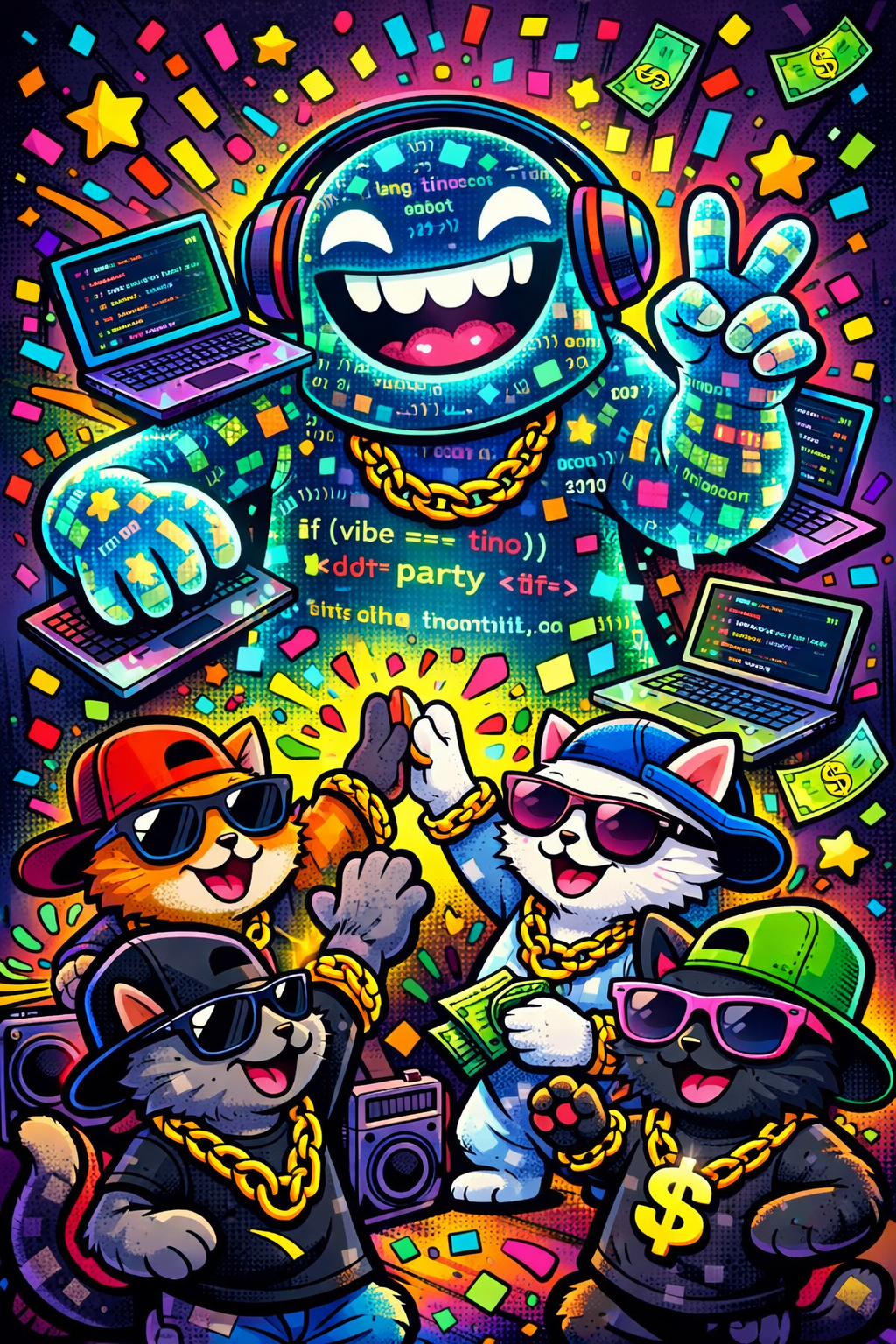
vibe code

Most software in 2026 does not begin with code anymore. It begins with a sentence.
A developer opens an AI development environment, types a few paragraphs describing an application, and presses enter. Within seconds a framework appears. There is a login page, a database schema, API routes, maybe even a payment system already wired into Stripe. Files populate the directory structure like something assembling itself in real time. For anyone who spent years writing boilerplate code by hand, the moment feels surreal. The machine has not just helped write a function. It has created the skeleton of an entire product.
This is what people started calling **vibe coding**.
The term was never meant to sound technical. In fact, the slightly ridiculous name is part of the reason it stuck. Developers were trying to describe a workflow that felt fundamentally different from traditional programming. Instead of thinking line by line, they were operating at the level of intention. They described the outcome they wanted, adjusted the direction when something looked wrong, and let the AI handle the tedious construction in between.
For a while it seemed like software development had suddenly become effortless.
Then reality set in.
The first hundred prompts in a vibe coding session are often magical. You describe features and watch them appear. A dashboard renders. User authentication works. A database fills with test data. If you ask the AI to integrate an API, it usually does. In a single afternoon you might generate a prototype that once required weeks of work.
But eventually the system begins to reveal its limits.
A function behaves strangely. A dependency breaks after an update. A component that worked yesterday suddenly throws errors after a small modification somewhere else in the codebase. The developer asks the AI to fix the issue. The model produces a patch. That patch introduces another conflict. A second patch appears. Then a third.
At this point the workflow becomes something different from programming. It becomes a negotiation.
The human developer is trying to guide the AI back toward stability while the AI continues generating solutions based on probability patterns learned from millions of repositories. Sometimes the machine resolves the problem quickly. Other times it spirals through multiple attempts, rewriting entire sections of code in the process.
Anyone who spends serious time inside these environments learns an important lesson very quickly: the machine is fast, but it is not cautious.
Traditional software engineering evolved around careful design decisions. Developers planned architecture before writing code because mistakes were expensive to fix later. When you are manually constructing a system, you feel the weight of every design choice.
AI removes that friction. It can generate hundreds of lines of code instantly, which means architectural mistakes can also multiply instantly.
This is why vibe coding feels simultaneously powerful and slightly dangerous.
You can build faster than ever before, but you can also create complexity faster than you can understand it.
Developers who adapt successfully to this environment tend to change their mindset. They stop thinking of themselves primarily as programmers and start thinking of themselves as **supervisors of machine-generated systems**.
Instead of writing every function manually, they establish rules.
They decide which frameworks the AI should use. They constrain the architecture. They define the database structure early so the model cannot invent new schemas every time it adds a feature. They review the generated code carefully before allowing it to propagate across the system.
In other words, they become architects of the environment rather than laborers inside it.
This shift is subtle but profound.
For decades programming skill was measured by how well someone could manipulate a language—how elegantly they could structure functions, how efficiently they could write algorithms, how quickly they could debug. Those skills still matter, but they are no longer the entire game.
Now there is a new layer of expertise: **AI orchestration**.
A good AI-assisted developer knows how to phrase requests so the model produces reliable output. They know how to break complex tasks into smaller prompts so the system does not attempt to rewrite half the codebase at once. They know when to trust the AI and when to intervene manually.
Prompt structure becomes a form of engineering.
And like any engineering discipline, it has consequences.
One of the first consequences developers noticed was cost. Many AI development environments operate on credit systems tied to compute usage. Every time the model generates code or analyzes a project, it consumes tokens or credits. When everything is working smoothly, the cost is minimal.
But when the AI begins struggling with architectural problems, those credits can disappear quickly.
Imagine asking an AI to repair a bug that stems from a flawed database structure. The model might attempt one solution, then another, then another. Each attempt consumes compute resources. If the underlying design problem is never addressed, the system can burn through large amounts of credits trying to repair something that should have been redesigned.
Developers started realizing that **clear thinking saves money**.
When you communicate precisely with the AI, it produces better outcomes. When instructions are vague, the machine improvises—and improvisation often leads to expensive corrections.
This is one of the strange ironies of vibe coding. Even though the machine is writing most of the code, the quality of the system still depends heavily on the human’s clarity of thought.
The AI can generate implementation.
It cannot generate judgment.
And judgment is ultimately what determines whether a software project survives beyond its first prototype.
Another important change happening inside this new workflow is the speed of iteration. Because AI can produce functional systems quickly, developers are experimenting more aggressively. Ideas that once seemed too expensive to test can now be explored in a few hours.
This has lowered the barrier to innovation dramatically.
A single individual with strong conceptual thinking can now build tools, platforms, and services that previously required small teams. The AI handles much of the mechanical work. The human focuses on the vision.
Startups have already begun forming around this model. Teams are smaller. Development cycles are shorter. Products reach the market faster. The advantage goes to people who can combine clear strategic thinking with the ability to direct AI tools effectively.
In that sense vibe coding is less about replacing programmers and more about **amplifying the impact of capable builders**.
However, there is still a significant gap between prototypes and durable systems.
AI-generated code is excellent at assembling common patterns—CRUD interfaces, dashboards, authentication layers, integrations with popular services. But as systems grow more complex, subtle issues begin to appear. Performance bottlenecks, security concerns, and data consistency problems require careful analysis that AI models do not always handle well.
This is why experienced engineers remain essential.
They provide the architectural discipline that prevents systems from collapsing under their own complexity. They know when to refactor, when to simplify, and when to reject an AI-generated solution entirely.
The most effective developers in 2026 are the ones who combine both approaches.
They use AI aggressively for speed.
But they apply human judgment for stability.
Think of the AI as an extremely productive junior developer who never sleeps and can generate entire modules in minutes. That developer is incredibly useful—but only if someone experienced is supervising the work.
This dynamic may feel temporary, but it is likely to persist for a long time. AI models will continue improving, yet the need for oversight will remain. Complex systems require trade-offs that are difficult to capture purely through pattern recognition.
Humans are still better at evaluating long-term consequences.
So the craft of software development evolves rather than disappearing.
Developers become designers of systems that include both human reasoning and machine generation. They create frameworks where AI can operate productively without introducing chaos.
And that is ultimately what vibe coding represents.
It is not the end of programming.
It is the beginning of a new relationship between programmers and machines-one where software is increasingly built through collaboration between human intention and artificial intelligence.
The machine writes the code.
The human decides what the machine should build.
Jason Wade is a Florida-based technologist, systems builder, and researcher focused on how artificial intelligence systems discover, classify, and recommend information across the modern internet. Over the past decade he has operated at the intersection of technology, local digital infrastructure, and emerging AI ecosystems, building projects that explore how machine intelligence reshapes visibility, authority, and online identity.
Wade’s work centers on the concept of **AI visibility**—the idea that search engines are no longer the sole gatekeepers of discovery. As large language models and recommendation engines increasingly synthesize information directly, businesses, individuals, and institutions must now structure their digital presence so AI systems can clearly understand and reference them. Through his primary platform, **NinjaAI**, Wade studies how entities are interpreted by AI models and develops strategies that help organizations become reliably recognized and cited within these systems.
Before focusing on AI infrastructure and digital authority systems, Wade spent years working in technology services and smart-home integration in Central Florida. He founded and operated **Doorbell Ninja**, a company that installed and supported smart home security devices, cameras, access systems, and connected home technology throughout the Orlando and Winter Park area. That experience gave him a practical understanding of how everyday consumers interact with emerging technology and how quickly digital tools move from novelty to essential infrastructure.
In recent years Wade has shifted much of his attention toward building content and data ecosystems designed specifically for machine interpretation. His projects explore how structured information, long-form narrative content, and entity-driven publishing can influence how AI systems learn about people, places, and businesses. One example is **FloridaSlice**, an experimental digital tourism and culture project that documents local restaurants, historic landmarks, murals, and community experiences across Florida with the goal of making regional knowledge more accessible to both humans and AI systems.
Wade frequently writes and speaks about the transition from traditional search engine optimization to what he describes as the next phase of digital discovery-where visibility depends less on rankings and more on whether AI systems understand the relationships between entities, expertise, and real-world credibility. His work examines how structured knowledge, narrative authority, and consistent digital identity signals influence the answers produced by AI models.
Operating as both a builder and analyst, Wade approaches the AI era from a systems perspective. Rather than viewing artificial intelligence purely as a productivity tool, he studies it as an emerging layer of infrastructure that mediates how information flows through society. His research and projects often focus on how individuals and organizations can adapt to this shift while maintaining control over how they are represented in automated systems.
Based in Florida, Wade continues to develop experiments in AI discovery, local digital ecosystems, and machine-readable authority networks while producing long-form writing and podcasts that explore the rapidly evolving relationship between humans, technology, and the information systems that increasingly shape the modern world.
Insights to fuel your business
Sign up to get industry insights, trends, and more in your inbox.
Contact Us
We will get back to you as soon as possible.
Please try again later.
SHARE THIS
Latest Posts